Share
New series of “UniCath Dialogues” launched at the Catholic University of Croatia: First discussion explores human greatness and vulnerability
A new series of UniCath Dialogues began on October 28 in the Council Hall of the Rectorate building of the Catholic University of Croatia (CUC), marking the start of the 2026/2027 academic year's programme. This year's series consists of five discussions inspired by Pope Leo XIV's encyclical Magnifica humanitas. The first event focused on the topic "The greatness and vulnerability of humanity (Foundations of Christian anthropology)".
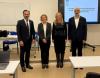
The participants were welcomed by the Rector of CUC, Prof. Željko Tanjić, PhD, who expressed his satisfaction that this was the first event held in the renovated Rectorate building. The Head of the University Department of Theology, Prof. Odilon Singbo, PhD, presented the series as one of the Department's projects for the academic year and introduced the speakers: Prof. Nenad Malović, PhD, from the Catholic Faculty of Theology at the University of Zagreb, and Asst. Prof. Kristina Vujica, PhD, an external associate of CUC.
In his lecture, Professor Malović examined the human condition from the perspectives of philosophical and theological anthropology, connecting historical and contemporary reflections with the messages of the encyclical. From a biological perspective, he described human beings as among the weakest and most vulnerable creatures in nature, dependent on others from the moment of birth. Unlike animals, which possess natural means of survival, human strength lies in what we call logos – the capacity for thought, speech, and the search for meaning.
It is precisely this capacity that has enabled humanity to overcome its natural limitations and gain control over many aspects of the surrounding world. From the invention of the wheel to the development of artificial intelligence, human beings have used reason to adapt nature to their needs. However, the professor warned of the dual nature of progress and the difficulty of predicting its long-term consequences, citing the example of plastic, which has evolved from a useful invention into a serious environmental problem. Pope Leo XIV also addresses this dual nature of progress in the encyclical, warning that new technologies open up possibilities whose impact on individual dignity and the common good remains difficult to predict.
Reflecting on historical attempts to create "perfect societies" through totalitarian systems, Malović pointed out that they all shared a disregard for human dignity. Human dignity cannot be taken away in an ontological sense, as it constitutes the very essence of humanity, but it can be violated and denied. The encyclical Magnifica humanitas therefore identifies the preservation of every person's dignity as one of the fundamental goals of human activity and a key criterion of genuine progress.
While human greatness is manifested in scientific, cultural, and artistic achievements, it is particularly evident in community with others and concern for the common good. The professor went on to discuss the relational nature of human existence, which does not diminish with age and increased vulnerability but becomes even more pronounced. He highlighted the paradox of the digital age: while we multiply connections and followers through social media, we simultaneously experience feelings of emptiness and loneliness.
Referring to the encyclical, Malović conveyed the Pope's call to cultivate genuine, physical presence through sharing meals, participating in Christian communities, and serving the poor. In conclusion, he emphasised that human beings exist within an inseparable network of four relationships – with themselves, nature, the community, and God. It is precisely the relationship between human greatness and fragility that becomes an important criterion for evaluating the anthropological models offered by contemporary culture. Accepting one's own finitude and limitations does not diminish a person but opens them to recognising the inviolable dignity of others.
Assistant Professor Kristina Vujica approached the topic from a philosophical and theological perspective, emphasising that, in Christian anthropology, the human person remains an open question and a being called to vigilance. Drawing on the thought of theologian Paul Tillich, she explained the ontological duality of human greatness and vulnerability through three key principles of Christian tradition:
The principle of essential goodness (Esse qua esse bonum est): Reality and human beings are fundamentally good. Created in the image of God (imago Dei), the human person is endowed with everything necessary for a dynamic communion with God.
The principle of the Fall and self-alienation: Separated from their own essence and from God, modern human beings suffer from a loss of identity, feelings of emptiness, and meaninglessness. Vujica explained that sin, in an ontological sense, is not merely a violation of rules but an alienation from one's original essence. She noted that the reflections of secular thinkers such as Sartre, Heidegger, and Freud also reveal an underlying assumption about an original human essence and the problem of humanity's alienation from it.
The principle of salvation: Since this is an ontological problem involving anxiety, finitude, and death, human beings cannot free themselves from such a condition solely through their own efforts. Even the most advanced medical or psychological methods cannot provide a definitive answer to the question of human existence. Therefore, human beings need not only psychological healing but also salvation (Latin: salus – health, salvation).
In this context, Vujica highlighted a thought from the encyclical, drawn from the Pastoral Constitution Gaudium et spes, according to which the mystery of the human person becomes clear only in the mystery of the Incarnate Word. Christ does not offer technological substitutes or the idea of a "superhuman" but brings salvation to human beings at the very centre of their existence.
Discussing the logic of love as opposed to the logic of power, Vujica warned that modern individuals often evaluate their own worth through success, power, and social recognition. In contrast to this approach, Christ introduces the logic of self-giving (agape) – to be fully human means to be willing to give oneself to others.
She also pointed to the contradictions of contemporary life, describing the modern person as "overfed yet hungry, sluggish yet overburdened", someone who seeks to avoid suffering and vulnerability. She emphasised that human greatness is not manifested in the elimination of every weakness but also in the ability to accept the tension between greatness and vulnerability.
"History has shown that wherever the human person has been misunderstood, God has also been misunderstood. Therefore, we care about humanity because we care about God," Assistant Professor Vujica concluded, adding that human beings can find security precisely through trust and a relationship with God.
The lectures were followed by a discussion during which participants had the opportunity to ask the speakers questions. The event continued until 8 PM and concluded with an informal gathering and refreshments.