Share
At the crossroads of the Middle Ages and the Early Modern Period - national professional and scholarly conference for history teachers in Croatia
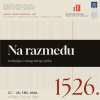
Immediately ahead of the 500th anniversary of the Battle of Mohács, the national professional and scholarly conference for history teachers “At the Crossroads of the Middle Ages and the Early Modern Period” will be held at the Catholic University of Croatia in Zagreb on August 27 and 28, 2026. The plenary part of the programme will take place in Aula Magna, while the afternoon sessions on both days will be dedicated to workshops for teachers. The conference is jointly organized by the University Department of History of the Catholic University of Croatia and the Education and Teacher Training Agency.
The cooperation between the two institutions in organizing conferences for history teachers dates back to 2018, when the first joint conference, “Historical Sources in Historiography and Teaching,” was held. It was followed by “Zagreb Through the Centuries” in 2022, “History Teaching in Theory and Practice” in 2023, and “King Tomislav and Historiography - (1)100 Years Later” in 2025. This year's conference, “At the Crossroads of the Middle Ages and the Early Modern Period,” is the fifth in the series. It was initiated by Marijana Marinović, MA, Senior Advisor for History Teaching at the Education and Teacher Training Agency, who proposed the topic and concept of the conference.
The programme is designed to connect scholarly presentations with concrete questions concerning history teaching and the work of teachers in the classroom. The opening addresses will be delivered by Rector of the Catholic University of Croatia Professor Željko Tanjić, PhD, and Director of the Education and Teacher Training Agency Katarina Milković, MA. The morning programme on both days will be moderated by Vjera Brković, PhD, Senior Lecturer. More than 170 history teachers from across Croatia have registered to participate in the conference so far.
The 500th anniversary of the Battle of Mohács provides the immediate occasion for the conference, but its concept goes beyond the event itself. Recent research places Mohács within the broader context of Ottoman pressure, political and dynastic changes, and transformations of the Kingdom of Hungary-Croatia and Central European space, while also questioning its later interpretations as a boundary between historical periods and a symbol of “decline.” The first day of the conference will offer different perspectives on the political, social, religious, and cultural processes connected with Mohács and the transition to the Early Modern period. Professor Hrvoje Kekez, PhD, will speak about the Blagaj counts and family strategies during the period of Ottoman threat, while Associate Professor Mario Bara, PhD, will address linguistic contacts, confessional boundaries, and the emergence of the name Šokac. Robert Skenderović, PhD, will examine the collapse of the hierarchy of the Catholic Church in Slavonia following the Battle of Mohács; Assistant Professor Valentina Janković Barbarić, PhD, will discuss the identities and social roles of Ban and Bishop of Zagreb Šimun Bakač Erdödy; and Veronika Novoselac, MA in History and MA in Communication Studies, will examine how the Battle of Mohács was shaped in Croatian historiographical and literary narratives.
On the second day, the focus will shift towards the political consequences of this turning point and the transformations of Croatian lands during the 16th century. Assistant Professor Luka Špoljarić, PhD, will speak about Croatian magnates and the challenge of state-building in the Late Middle Ages, while Professor Ivan Majnarić, PhD, will address the Cetingrad congregatio generalis of 1527 and expressions of the pre-modern nation. The programme will continue with a presentation by Associate Professor Denis Njari, PhD, on the Hungarian perspective on Mohács, the culture of remembrance, and the national narrative, followed by a presentation by Damir Stanić, PhD, on the characteristics and consequences of the militarization of Croatian lands in the 16th century.
An equally important part of the programme consists of workshops led by history teachers from primary and secondary schools. On the first day, participants will engage in practical work on the development of weapons and military technology during the Ottoman conquests, migrations at the transition from the Middle Ages to the Early Modern period, the use of historical sources on the Ottoman conquests in teaching, and their consequences in Istria. On the second day, the workshops will cover Pazin Castle at the crossroads of the Middle Ages and the Early Modern period, the jigsaw method in teaching a local history topic on Istria and Tar in the 16th century, and Matthias Flacius Illyricus as a reformer, scholar, and European. The workshop programme will be moderated by Senior Advisors at the Education and Teacher Training Agency Marijana Marinović, MA, and Hrvoje Knežević, Professor.
“At the Crossroads of the Middle Ages and the Early Modern Period” therefore takes Mohács as its starting point, but does not stop there. The battle of 1526 opens a discussion on the political changes, warfare, migrations, religious divisions, and transformations of identity that shaped Croatian and Central European lands during the 16th century. Particular attention will also be given to the ways in which Mohács was subsequently interpreted in historiography, literature, and the culture of remembrance. The workshops will provide teachers with content, sources, and approaches that they can apply directly in their teaching.