Share
Professor Kekez Guests on the Večernji TV Podcast "Historical Dialogues"
Professor Hrvoje Kekez, PhD, from the University Department of History, appeared as a guest on the Večernji TV podcast "Povijesni dijalozi" ("Historical Dialogues"), hosted by Ivan Tepeš. During the conversation, he discussed early modern Croatian history, with a particular focus on the Battle of Krbava Field, the Parliament of Cetin, and the long-term consequences of Ottoman conquests on Croatia's borders and demographic landscape.
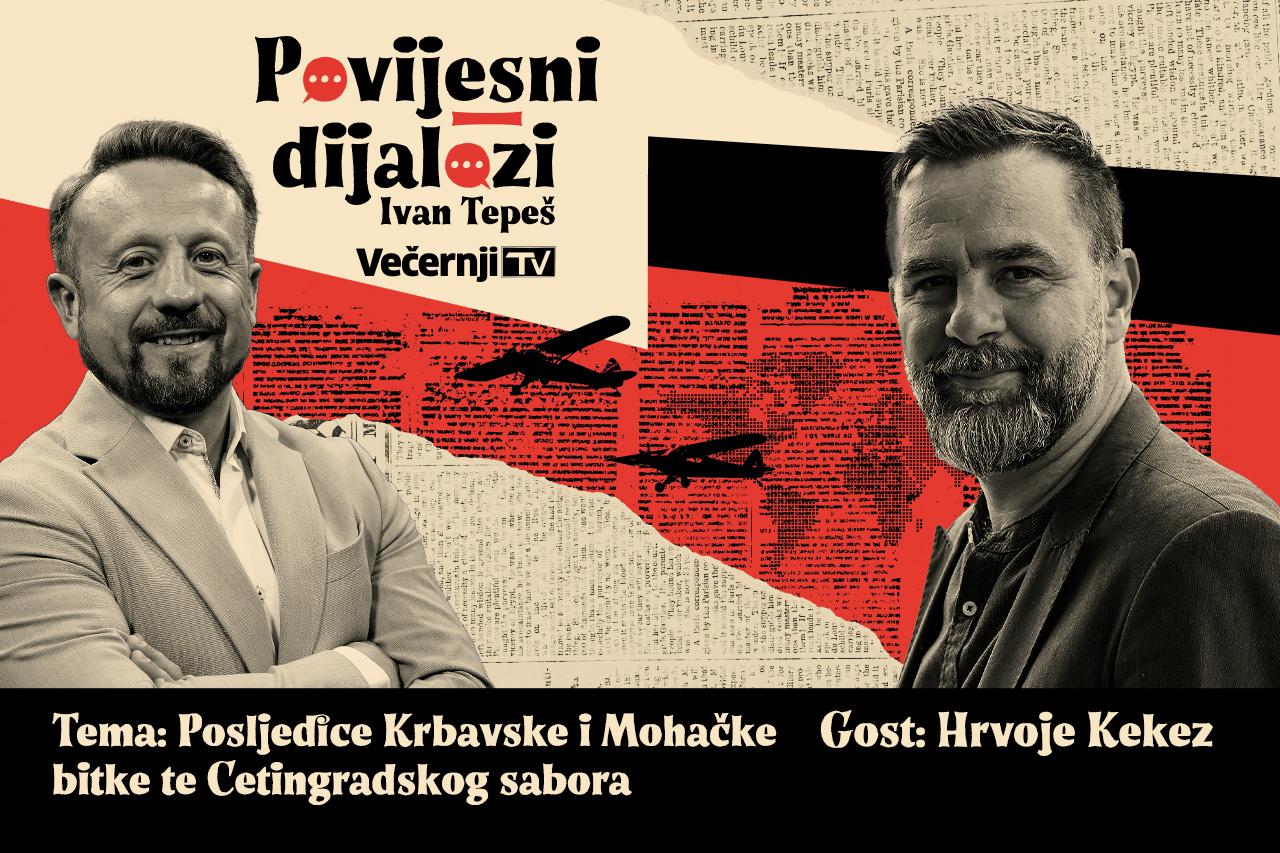
As one of the central themes of the discussion, Kekez highlighted the upcoming 500th anniversary of the Parliament on Cetin (Cetinski sabor), held in 1527 in the Franciscan monastery beneath the fortress of Cetin. He underlined its exceptional significance for Croatian history and the fact that it is explicitly referenced in the historical foundations of the Constitution of the Republic of Croatia. Following the crushing defeat of the Hungarian-Croatian army at the Battle of Mohács in 1526 and the death of King Louis II of the Jagiellonian dynasty, the Croatian estates assembled in Cetin and independently elected Ferdinand of Habsburg as their king, subject to his pledge to defend Croatian territories against the Ottomans.
Addressing the Battle of Krbava Field in 1493, Kekez addressed common misconceptions suggesting that this battle marked an immediate collapse of the Croatian kingdom. Although the defeat at Krbava Field had immense consequences, the Ottoman conquest of the area unfolded gradually over the ensuing decades. The battle resulted in the loss or capture of a large segment of the Croatian social, political, and military elite of the time, including prominent members of noble houses such as the Frankopan, Zrinski, and Blagaj families.
Kekez identified mass population displacement throughout the second half of the 15th century and the entire 16th century as one of the most critical long-term consequences of Ottoman incursions. Waves of refugees moved toward the Dalmatian islands and across the Adriatic Sea to Molise, Italy, where their descendants reside to this day. Concurrently, domestic institutions were weakened, and the Diocese of Zagreb gradually emerged as one of the key pillars of political and social continuity in the remaining Croatian territory.
Continuing the discussion, Professor Kekez outlined the gradual shaping of Croatian borders, from the era of the "remnants of the remnants" (reliquiae reliquiarum) of Croatia to the Ottoman retreat following the Great Turkish War and the Treaty of Karlowitz in 1699. He also addressed the northwestern shift of the Croatian name, as well as the enduring impacts of the Ottoman wars on Croatian society and collective memory. Particular attention was devoted to the ways in which memories of the Ottoman wars were constructed and utilized over the centuries, including their political instrumentalization following the First World War.
At the conclusion of the conversation, Kekez elaborated on the historical foundations of the Sinjska Alka and the Picokijada festival in Đurđevac, presenting them as examples of living historical memory and vital elements of contemporary Croatian identity. These topics, alongside new findings concerning the Battle of Krbava Field, are explored in greater detail in his new book dedicated to Krbava Field in 1493.
You can watch the full episode below: