Share
Assistant Professor Brgles Publishes Chapter in the Book "Catholic Social Thought and Social Innovation"
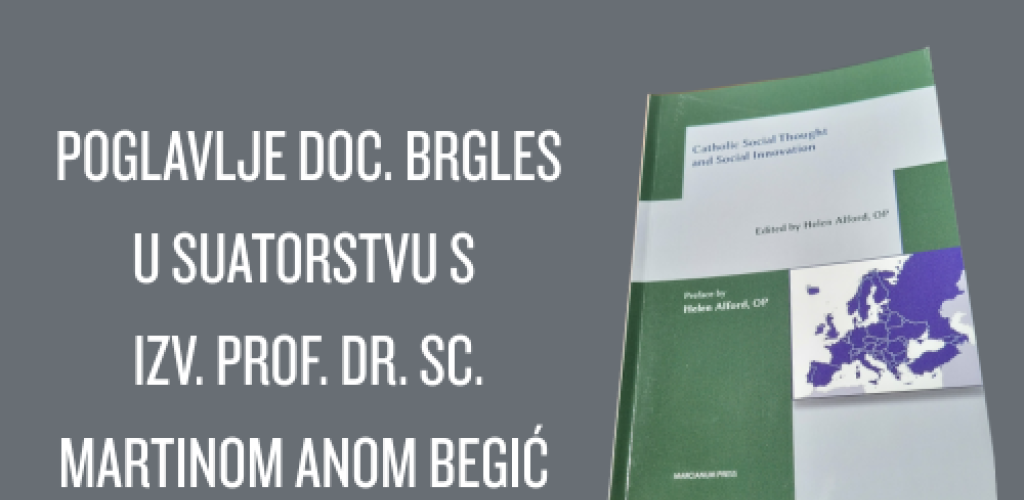
Marcianum Press has published the book Catholic Social Thought and Social Innovation, featuring contributions from scholars from Central and Eastern Europe who participated between 2021 and 2024 in the CREATE programme (The Catholic Social Teaching Rome Exchange: Advanced Training Experience) at the Faculty of Social Sciences of the Pontifical University of St. Thomas Aquinas – Angelicum in Rome. The volume is edited by Prof. Helen Alford, OP, Ph.D., Dean of the Faculty and President of the Pontifical Academy of Social Sciences. In her Preface, Alford highlights the importance of defining social innovations, referring to Giuseppe Toniolo who, as early as 1873 at the University of Padua, emphasised the role of moral convictions in shaping economic decisions with the aim of producing sustainable economic outcomes. While Toniolo relied solely on historical examples, Alford notes that today—150 years later—empirical research can substantiate these insights.
The book is structured into three sections: Innovation and Catholic Social Thought in Economics and Politics; Innovation, Catholic Social Thought and Theology; and Innovation, Catholic Social Thought and Lay Leadership.
Assistant Professor Brgles, together with Assoc. Prof. Martina Ana Begić, Ph.D., authored a chapter entitled How to Research the Faith and Religion of Young People? A New Multidimensional Model for In-Depth Research, which is an expanded translation of selected sections from their book Zrcala i sjene vjere. In the first part of the chapter, Begić presents the meaning and role of faith in human life from a theological perspective. In the second part, Brgles provides a brief overview of significant works by sociologists of religion, focusing particularly on Glock’s multidimensional model of religiosity. Glock’s framework encompasses five dimensions: the ideological dimension of belief, the ritual dimension, the experiential dimension, the intellectual dimension of religious knowledge, and the ethical dimension of religious practice.
Brgles proposes extending the model with an additional dimension—evangelisation—and explains which qualitative methods may be used to explore each dimension. In the context of social innovations, research on religiosity—together with theological insights into the essence and content of faith—can further illuminate the moral convictions Toniolo described, as well as the cultural context and ethical aspects of action. This contributes to understanding how and why innovations develop in accordance with the values of a community.